
Types of Mechanical Components You Can Estimate With AI-Powered Mechanical Estimating Software
AI-powered mechanical estimating software automatically identifies, counts, and quantifies mechanical components from construction drawings, helping contractors produce faster, more accurate bids with far less manual effort.
Mechanical estimating is detailed, time-sensitive, and expensive when mistakes happen. Missing a branch line, fitting, or insulation run on a large commercial project can quickly impact profitability and project timelines.
That is why AI estimating technology has become such a practical tool for mechanical contractors. The question most estimators ask is simple: what can the software actually handle? The answer is broader than most expect.
Quick Summary
- AI mechanical estimating software handles HVAC, piping, ductwork, valves, fittings, plumbing fixtures, insulation, and equipment from a single drawing set.
- Platforms like TaksoAi dramatically reduce the time required for manual takeoffs while improving component-level accuracy.
- Automated workflows minimize the human error patterns that most affect mechanical bids: missed fittings, inconsistent counts, and overlooked branch connections.
- AI estimating technology is built for real mechanical projects, not generic construction workflows, making it practical from day one.
- Contractors of all sizes benefit from faster bid turnaround, higher bid volume, and more reliable estimates.
HVAC Systems: Where AI Estimating Delivers Immediate Value
HVAC components are among the most complex systems to take off manually. A single commercial floor plan can include dozens of air handling units, fan coil units, VAV boxes, rooftop units, exhaust fans, and associated equipment, each connected by ductwork runs that branch, transition, and change direction across multiple zones. Tracking every piece without missing something is a real challenge when working under bid deadlines.
The Whole Building Design Guide notes that HVAC systems are among the most coordination-heavy systems in commercial construction, which is one reason accurate takeoffs matter so much early in the estimating process.
With TaksoAi AI estimating software, estimators can identify and quantify HVAC equipment directly from uploaded construction drawings. The AI reads through the plans and extracts components with a level of speed and consistency that manual methods simply cannot match.
ASHRAE’s HVAC design resources highlight how modern mechanical systems involve interconnected equipment, controls, piping, and airflow coordination that can quickly complicate manual estimating workflows. Equipment schedules, unit tags, and associated mechanical connections are all processed as part of a unified workflow, rather than tracked across separate spreadsheets.
For HVAC contractors, this translates directly into faster bid turnaround, fewer missed items, and greater confidence when submitting proposals on competitive projects.
Piping Systems: Automated Quantification From Branch to Main
Piping is one of the most labor-intensive systems to estimate manually. A commercial project can include hundreds of linear feet of pipe across multiple diameters, materials, and service types, including domestic water, hydronic heating and cooling, medical gas, compressed air, and process piping. Every segment needs to be measured, every fitting counted, and every change in direction or diameter accounted for.
As commercial mechanical systems become more interconnected, estimating accuracy becomes increasingly important for maintaining system performance, material coordination, and installation efficiency throughout a project lifecycle.
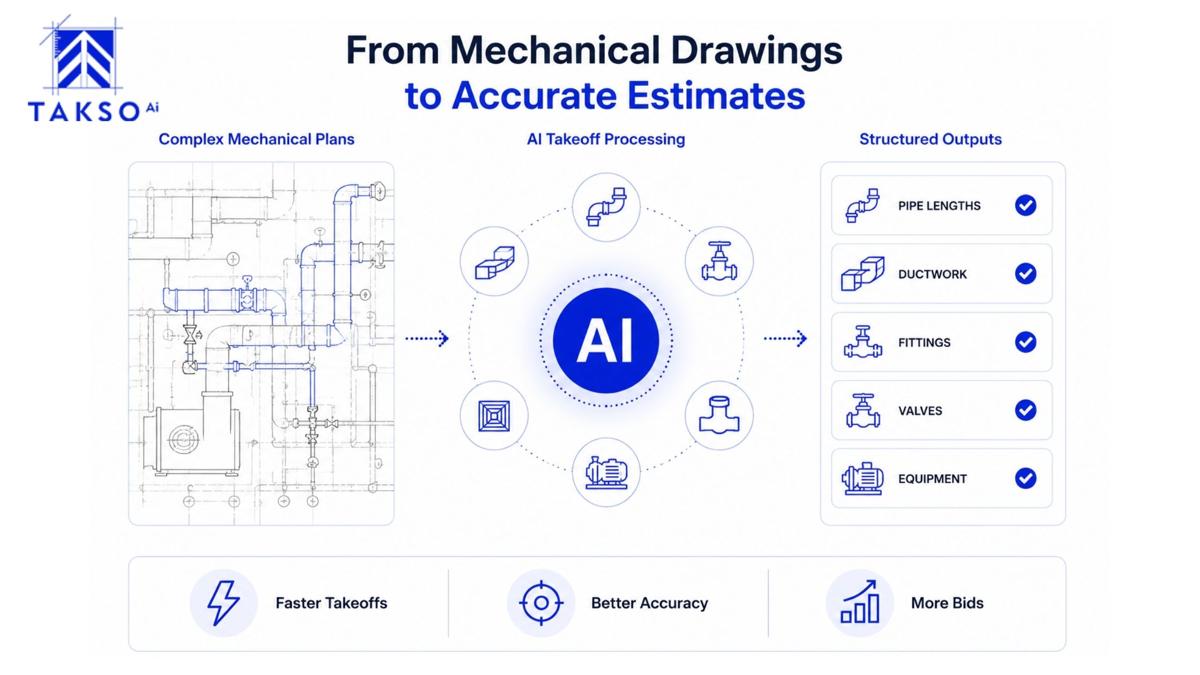
Using AI piping estimating software, the platform processes drawings to extract pipe lengths, identify branch connections, and flag fittings such as elbows, tees, reducers, and couplings. This is not a simple PDF measurement tool. The AI understands the context of a piping layout, distinguishing between main runs and branch lines, and associating fittings with the correct pipe segments.
The practical benefit for estimators is substantial. Piping takeoffs that once required a full day of careful manual work can be completed in a fraction of the time, with the added advantage of an auditable, organized output that is easy to review and adjust before the bid goes out.
Ductwork and Sheet Metal: Accurate Takeoffs on Complex Layouts
Ductwork estimation is notoriously difficult to get right. Rectangular duct, round duct, oval duct, flexible connections, transitions, and fittings all need to be quantified accurately, and layouts often change significantly between architectural, mechanical, and coordination drawings. Missing a major trunk run or miscalculating the square footage of a duct section leads directly to cost overruns in the field.
Even relatively small changes in duct sizing and airflow velocity can significantly affect system performance and material requirements, which is why accurate duct quantification matters during estimating.
AI-powered mechanical estimating software handles ductwork by identifying and measuring duct segments, calculating area or volume based on duct dimensions, and enumerating associated components such as dampers, grilles, registers, and diffusers. Complex layouts that would require multiple passes on a manual takeoff can be processed systematically, reducing the risk of overlooked transitions or miscounted outlets.
This is one area where the structured, system-aware approach of AI estimating makes a noticeable difference over simpler PDF measuring tools.
Valves and Fittings: The Components That Are Easiest to Miss
Ask any experienced mechanical estimator where the errors tend to hide in a manual takeoff and the answer is usually the same: fittings and valves. They are small, numerous, and easy to overlook when attention is focused on longer pipe runs or major equipment. But valves and fittings represent real material and labor cost, and a pattern of missing them erodes bid accuracy in a way that compounds across projects.
This is one of the most direct advantages of using AI mechanical estimating software. The platform is designed to identify and count these components systematically, including gate valves, ball valves, check valves, butterfly valves, pressure reducing valves, backflow preventers, elbows, tees, reducers, unions, and flanges. Every fitting gets captured as part of the AI-driven takeoff process, rather than depending on estimator vigilance during a manual count.
For mechanical contractors who bid regularly on complex commercial or industrial projects, this level of component-level accuracy makes a meaningful difference in bid reliability.
Plumbing Fixtures and Rough-In Components: Fast Counts From Full Drawing Sets
Plumbing fixture counts are essential to accurate mechanical estimates, covering everything from toilets, sinks, urinals, and floor drains to water heaters, mixing valves, and trap primers. On large commercial projects, a full drawing set can include dozens of fixture types spread across multiple floors and wings, with associated rough-in requirements that vary by fixture type and local code.
TaksoAi processes plumbing plans to identify and count fixtures by type, pulling from plan views, schedules, and elevation drawings where applicable. This gives estimators a structured fixture count they can cross-reference against the project specification, rather than manually tallying each item across a large set of drawings.
Rough-in components including supply and waste connections, cleanouts, and access panels are captured as part of the same workflow, ensuring nothing slips through when the plumbing scope is being quantified.
Insulation: Quantified by System, Material, and Thickness
Insulation is another component category where manual estimates frequently run into problems. Pipe insulation varies by service type, pipe diameter, and ambient conditions. Duct insulation varies by system and location. Getting the quantities right requires tracking insulation across multiple systems simultaneously, which is time-consuming and error-prone when done by hand.
The CDC and NIOSH continue to emphasize the importance of properly designed ventilation systems in commercial buildings, which places even greater importance on accurate mechanical system estimation and coordination.
With AI takeoff software for contractors, insulation quantities are derived directly from the underlying pipe or duct takeoff. As the AI quantifies pipe lengths and duct areas, insulation can be calculated based on the applicable specification requirements, categorized by material type, thickness, and system. This eliminates a separate insulation takeoff step and ensures that insulation quantities stay aligned with the actual piping and ductwork being installed.
For mechanical contractors who self-perform insulation or manage it as part of a broader scope, having insulation quantities broken out with this level of clarity simplifies both estimating and procurement.
Mechanical Equipment: Schedules, Tags, and Specifications All in One Pass
Large commercial and industrial projects often include complex equipment schedules covering air handling units, pumps, boilers, chillers, heat exchangers, cooling towers, hydronic terminal units, and specialty equipment. Reading through these schedules manually, matching equipment tags to plan locations, and verifying that every piece of equipment is captured in the estimate is a process that takes real time and attention.
Commercial mechanical equipment must also align with evolving energy efficiency standards and performance requirements, making accurate equipment identification increasingly important during preconstruction planning.
AI-powered mechanical estimating software processes equipment schedules alongside the associated plan drawings, linking equipment tags to their locations and extracting key specifications needed for accurate pricing. This means the estimator is working from a complete, organized equipment list rather than constructing one from scratch through manual review.
The result is a more reliable estimate and a faster bid preparation process, two outcomes that matter on every project regardless of size or complexity.
Why Estimators Find AI Takeoff Workflows Intuitive From Day One
One concern estimators sometimes raise about new technology is the learning curve. Will the platform require weeks of training before it becomes useful? For most teams, the answer with AI-powered estimating tools is no.
TaksoAi is built around the actual workflow of a mechanical estimator, not around the assumptions of a software designer who has never bid on a mechanical project. Drawings are uploaded, components are identified and organized by system, and the output is structured in a way that maps to how estimators actually build and review their takeoffs. The goal is to remove friction, not add it.
Support resources, including onboarding assistance and training materials, are available to help teams get up to speed quickly. Most estimators find that after a few projects, the AI-assisted workflow becomes their default approach rather than a supplement to manual methods.
Frequently Asked Questions About AI Mechanical Estimating
Can AI estimating software handle drawings that are not well organized or clearly labeled?
Yes. While clean, well-structured drawings produce the best results, AI estimating platforms like TaksoAi are trained to handle real-world drawing conditions, including inconsistent labeling, overlapping layers, and non-standard layouts. The software flags areas of uncertainty so estimators can review and confirm before finalizing.
How does AI estimating handle multi-system projects with overlapping mechanical scopes?
AI-powered platforms such as TaksoAi are designed to process multiple mechanical systems from the same drawing set, organizing output by system type so HVAC, piping, plumbing, and ductwork scopes can be reviewed independently or together. This is one of the core advantages over manual methods, which often require separate passes for each system.
Is AI mechanical estimating software suitable for smaller contractors, or is it built for large firms?
The efficiency gains from AI estimating are relevant at every scale. Smaller contractors benefit from faster takeoffs that free up time for more bids, while larger firms gain consistency and reduced error rates across high-volume estimating workflows when they use TaksoAi.
What types of construction drawings can be uploaded for AI takeoff processing?
Most AI mechanical estimating platforms accept standard construction drawing formats, including PDF plan sets and digital drawings exported from common CAD and BIM tools. This covers the majority of what estimators encounter on real projects.
Key Takeaways
- AI-powered mechanical estimating software handles HVAC, piping, ductwork, valves, fittings, plumbing fixtures, insulation, and equipment in a single integrated workflow.
- Automated takeoffs dramatically reduce the time required for component identification and quantification, allowing estimators to focus on pricing strategy and bid review.
- AI estimating minimizes the human error patterns that most often affect mechanical bids: missed fittings, inconsistent counts, and overlooked branch connections.
- Platforms like TaksoAi are designed around real mechanical estimating workflows, not generic construction software adapted for mechanical use.
- Teams of all sizes benefit from AI-assisted takeoffs, whether the goal is faster bid turnaround, higher bid volume, or more accurate and reliable estimates.
Start Estimating Smarter on Your Next Mechanical Project
The range of mechanical components that AI estimating software can handle is broader than most contractors expect, and the impact on bid speed and accuracy is significant from the first project. Whether your work centers on commercial HVAC, industrial piping, plumbing systems, or a combination of all three, the technology is ready to handle the complexity.
If you are ready to see what AI-assisted takeoffs can do for your estimating workflow, request a demo today and discover how TaksoAi is helping mechanical contractors estimate with greater speed, accuracy, and confidence on every bid.