
The Rise of Supplier-Led Takeoffs (And How to Keep It Profitable)

The role of suppliers in construction is shifting, and it is happening faster than most expected. What was once a clear boundary between contractors and suppliers is becoming increasingly blurred. Estimating, a responsibility traditionally handled in-house by contractors, is now being pushed downstream. More suppliers are being asked to support or complete takeoffs as part of the bidding process.
This is no longer an occasional request. It is becoming an expectation. For suppliers, this creates a complex position. There is clear upside in offering takeoff support, but it also introduces pressure, risk, and operational strain. The challenge is not whether to participate. It is how to do so in a way that protects margins and avoids unnecessary overhead.
Suppliers Are Being Pulled Into the Estimating Process
Across construction, contractors are looking for ways to move faster without expanding their own teams. Estimating is often where timelines slow down, especially for smaller contractors juggling multiple bids at once.
Suppliers are uniquely positioned to fill that gap. By providing takeoffs, suppliers move earlier into the project lifecycle. They are no longer responding to finalized material lists. They are helping shape them. This creates a stronger partnership and increases the likelihood of being included in the final project.
Industry frameworks have long emphasized the value of early collaboration and predictable estimating practices. For example, the Canadian Construction Association highlights how improved cost predictability depends on stronger coordination between stakeholders early in the project lifecycle.
In many cases, contractors now expect this level of support. With AI takeoff software for suppliers, teams are seen as more efficient, more collaborative, and ultimately more valuable.
The Opportunity Comes With Real Pressure
While the benefits are clear, the operational reality is more demanding. Suppliers are now expected to respond quickly to bid requests, often across multiple projects at once, while maintaining accuracy and consistency. This work is layered on top of existing responsibilities such as pricing, logistics, and client management.
The result is a growing strain on internal teams. Estimating requires focus and precision. When handled manually, it consumes time that could otherwise be spent on higher-value work. As demand increases, suppliers can quickly find themselves in a reactive cycle, trying to keep up without the resources to scale effectively.
This challenge is not new. Research from the National Institute of Standards and Technology shows that inconsistent estimating processes and unreliable data are among the most common contributors to cost overruns and inefficiencies in construction projects. This is where many begin to feel the tension between staying competitive and staying efficient.
Manual Takeoffs Are Not Built for This Shift
Traditional workflows were never designed to support this level of demand. Manual takeoffs rely heavily on experienced estimators who must measure, count, and extract quantities from drawings. Even when supported by construction estimating software, much of the process remains hands-on.
This creates limitations that become more pronounced under pressure. Turnaround times slow down, inconsistencies appear across projects, and the risk of errors increases as workloads grow.
Professional estimating standards reinforce just how structured this process is meant to be. Organizations like the Canadian Institute of Quantity Surveyors outline detailed methodologies for quantity takeoffs and cost planning, highlighting that estimating is a disciplined, methodical practice rather than a simple administrative task. The challenge is not just accuracy. It is scalability.
As expectations rise, the industry is moving toward automation and AI in supplier takeoffs. The shift is driven by necessity rather than preference. Manual workflows simply cannot keep up without significantly increasing cost.
The Traditional Barrier: Building an Estimating Team
For years, the only way for suppliers to offer takeoff support was to build internal estimating capabilities.
This meant hiring experienced estimators, investing in training, and creating new processes to manage incoming requests. It also meant committing to ongoing overhead, regardless of whether demand remained consistent.
For many suppliers, this created a difficult trade-off. Expanding into estimating could unlock new opportunities, but it also introduced financial risk and operational complexity.
In uncertain markets, that kind of commitment is difficult to justify. As a result, many suppliers have remained on the sidelines, even as the demand for takeoff support continues to grow.
Why Adapting Is No Longer Optional
Despite the challenges, the direction of the market is clear. Suppliers who support takeoffs are winning more business. They are becoming embedded earlier in projects, influencing material decisions, and strengthening relationships with contractors.
Those who do not adapt risk being excluded from opportunities altogether. This is not just an industry observation. Public sector estimating frameworks, such as those outlined by the Government of Alberta, emphasize how increasing levels of estimate detail and accuracy are expected as projects progress, reinforcing the importance of reliable quantity data early in the process.
This is not about offering an additional service. It is about aligning with how construction estimating is evolving.
A Smarter Way Forward With AI
The shift toward automation is changing what is possible for suppliers. Instead of building large estimating teams, suppliers can now rely on automated construction takeoffs to handle the most time-consuming parts of the process. These tools extract quantities, organize data, and produce structured outputs that can be reviewed and finalized quickly.
This fundamentally changes the workflow. Estimating becomes less about manual measurement and more about validation and decision making. Existing teams can handle more volume without being overwhelmed, and turnaround times improve without increasing headcount. Rather than replacing expertise, AI allows suppliers to apply it more effectively.
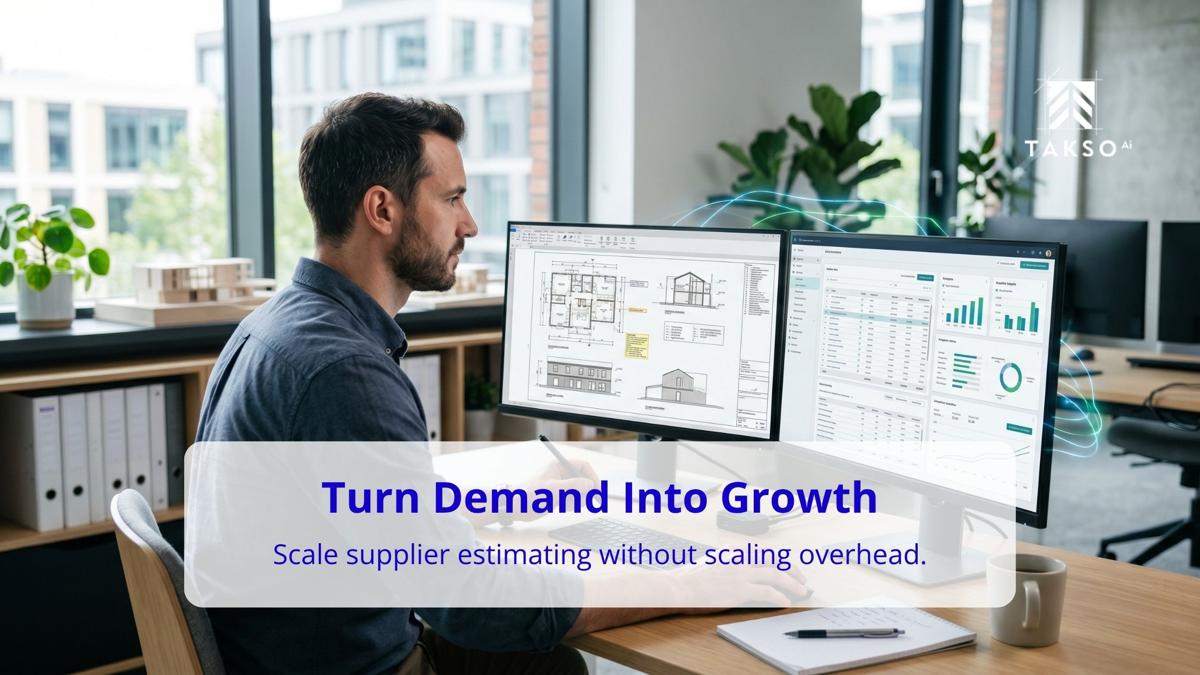
Turning Estimating Into a Competitive Advantage
When takeoffs are streamlined, the impact is immediate and measurable. Suppliers can respond to contractor requests faster, increasing their chances of being included in bids. They can handle more opportunities simultaneously without compromising quality. Most importantly, they can do all of this while maintaining control over internal resources.
What was once a bottleneck becomes a point of differentiation. This is where the benefits and capabilities of takeoff software become clear. Speed and accuracy no longer need to be traded off against one another. Instead, they work together to strengthen supplier relationships and improve overall performance.
Reducing Risk While Expanding Capability
One of the biggest advantages of AI-driven estimating is flexibility. Suppliers no longer need to commit to fixed overhead in order to offer takeoff services. They can start small, test demand, and scale their capabilities gradually. This creates a lower-risk path into estimating, one that aligns with how supplier businesses typically operate.
Solutions like piping estimating software designed for real supplier workflows integrate seamlessly into existing processes. They support how materials are quoted, priced, and delivered, rather than requiring a complete operational shift. This allows suppliers to expand their capabilities without disrupting what already works.
Accuracy Remains the Foundation
Speed is important, but accuracy is what builds trust. Contractors rely on supplier takeoffs to inform their bids, manage costs, and plan projects. Inaccurate data can have direct financial consequences, which is why supplier takeoff services and accuracy remain closely tied.
In practice, estimating accuracy is not static. Guidelines from the Ontario Ministry of Transportation show that estimates must be continuously updated, validated, and refined as more project information becomes available.
AI-driven tools support this by improving consistency and reducing manual variability. They provide structured outputs that can be reviewed and refined, rather than built from scratch each time.
Rethinking the Supplier Workflow
The rise of supplier-led takeoffs is reshaping how suppliers operate on a day-to-day basis. Instead of treating estimating as an occasional add-on, it is becoming part of a more integrated workflow. Requests come in, drawings are processed, outputs are reviewed, and structured estimates are delivered back to contractors in a fraction of the time.
This process is only sustainable when supported by the right tools. Understanding how AI is improving construction estimating provides context for why this shift is accelerating. The technology now supports real-world workflows, making it possible for suppliers to meet growing expectations without overextending their teams.
Key Takeaways
- Supplier-led takeoffs are becoming increasingly common as contractors look for faster estimating support and improved bidding efficiency.
- Manual takeoff workflows create scalability challenges by increasing workload pressure, slowing turnaround times, and introducing greater risk of estimating inconsistencies.
- Suppliers who provide estimating support earlier in the project lifecycle strengthen contractor relationships and improve their chances of winning repeat business.
- Tools like AI takeoff software for suppliers help suppliers increase estimating capacity without significantly expanding overhead or internal staffing.
- Modern workflows built around automated construction takeoffs allow suppliers to improve speed, consistency, and profitability while maintaining control over estimating accuracy and operational efficiency.
FAQs About Supplier-Led Takeoffs
Why are suppliers increasingly being asked to provide takeoff support?
Suppliers are being asked to provide takeoff support because contractors are managing tighter deadlines, leaner teams, and higher bid volumes. By helping with quantity extraction and estimating workflows, suppliers can improve project coordination earlier in the bidding process and help contractors respond to opportunities more efficiently.
What are supplier-led takeoffs?
Supplier-led takeoffs occur when suppliers assist contractors with quantity extraction, material calculations, and estimating support before bids are finalized. Instead of simply responding to completed material lists, suppliers become more involved in helping shape project estimates and supporting bidding workflows directly.
What are the risks of manual supplier takeoffs?
Manual supplier takeoffs can create slower turnaround times, inconsistent quantity extraction, and increased workload pressure on internal teams. As project complexity and bid volume increase, repetitive manual workflows also raise the risk of estimating errors, missed scope, and operational bottlenecks that reduce profitability.
How does AI improve supplier estimating workflows?
AI-driven estimating tools help suppliers automate repetitive quantity extraction tasks, organize estimating data more consistently, and handle larger bid volumes without significantly increasing workload. This allows teams to focus more on reviewing scope, validating quantities, and supporting contractor relationships rather than manual counting alone.
Can suppliers scale estimating support without hiring large estimating teams?
Yes. Modern estimating tools and automation platforms allow suppliers to expand takeoff support capabilities without building large in-house estimating departments. Solutions like piping estimating software help suppliers improve estimating efficiency while maintaining flexibility and controlling operational overhead.
Why is estimating accuracy important for suppliers?
Estimating accuracy directly affects contractor trust, project budgeting, and long-term supplier relationships. Inaccurate takeoffs can lead to material shortages, pricing problems, and project delays, while reliable estimating support helps suppliers become more valuable partners throughout the construction bidding and planning process.
Turning Pressure Into Opportunity
The rise of supplier-led takeoffs reflects a broader shift in construction. Responsibilities are being redistributed, expectations are increasing, and efficiency is becoming a key competitive factor.
For suppliers, this creates pressure, but it also creates opportunity. With the right approach, it is possible to stay competitive without expanding your team, respond faster to contractor needs, and protect margins while increasing output. The key is adopting tools and workflows that support this shift without introducing unnecessary overhead.
This is where solutions like TaksoAi come in. By enabling fast, accurate takeoffs without the need for a large estimating department, TaksoAi helps suppliers meet demand, maintain control, and scale their capabilities in a way that aligns with real business needs.
If you are looking to explore how this could work within your operation, you can request a demo of AI takeoff software and see how supplier estimating can become a practical, profitable extension of your business.