
How to Accurately Do Takeoffs from Blueprints

Blueprints do not usually destroy profitability all at once. They do it quietly. A missed valve buried in a plumbing riser. An underestimated duct run hidden in a ceiling detail. A fittings count that looked complete until procurement started and material expenses suddenly exceeded your estimate. This is how takeoff errors work.
For contractors, estimators, suppliers, and construction professionals, blueprint takeoffs are not just a pre-bid exercise. They are the foundation of accurate estimates, dependable material quantities, labor forecasting, project management, and risk management. Before markup, before pricing strategy, before bidding on a construction job, there is the blueprint takeoff. As the Whole Building Design Guide emphasizes in its cost estimating framework, accurate scope definition is one of the earliest controls over reliable project cost planning.
And if that foundation is flawed, everything built on top of it becomes vulnerable. Even experienced estimators can miss 5 to 15 percent of scope through manual takeoffs alone. That margin matters.
Missed components can lead to inaccurate estimates, calculation mistakes, weak contingency planning, inventory control issues, and costly errors that quietly erode profitability. Traditional methods still often rely on physical documents, scale ruler measurements, spreadsheets, hand measurements, and repetitive visual review.
Those systems can work. But they are also inherently prone to human error. TaksoAi helps teams strengthen blueprint takeoff workflows by reducing missed details, inconsistent manual counts, and repetitive quantity extraction problems. It modernizes the process without replacing proven estimator expertise. Because blueprint accuracy starts before pricing ever begins.
Blueprint Takeoffs Are Not Just Measurements, They Shape the Entire Estimate
A blueprint takeoff is the process of extracting material quantities and measurable project scope from plans in order to create accurate estimates.
That includes far more than simply measuring lengths.
A correct blueprint takeoff should capture:
Linear Components
Pipe, duct, conduit, cable tray, and measurable system runs.
Fittings
Elbows, tees, reducers, valves, dampers, transitions, and connectors.
Equipment
Fixtures, AHUs, RTUs, pumps, cranes, excavators, and specified equipment.
Accessories
Insulation, supports, hangers, fasteners, sleeves, and installation materials.
This is the real definition and purpose of takeoffs. They support bill of quantities creation, labor costs, material expenses, unit costs, indirect costs, and overall project estimates.
Many estimators undercount fittings. That is one of the most common hidden failures in blueprint takeoff.
Lengths often feel easier to track, but fittings, accessories, and smaller components are where blueprint takeoffs frequently lose accuracy. Missing these details creates downstream cost overruns, purchasing errors, and inaccurate calculations.
A blueprint takeoff is not just about counting. It is about building a dependable quantity takeoff that protects the full estimate.
Where Blueprint Takeoffs Quietly Go Wrong, Even for Skilled Estimators
Most takeoff errors are not caused by inexperience. They happen because manual systems create predictable opportunities for mistakes.
Visual overload
Dense blueprints filled with symbols, overlapping systems, and multiple sheet references create missed details.
Human fatigue
Manual takeoffs often become less accurate after prolonged repetitive review.
Scale misreads
Mixed scales across drawings or detailed views can distort measurements quickly.
Symbol inconsistency
Different design teams may use slightly different symbols, increasing room for interpretation errors.
Scope fragmentation
Specifications, schedules, reflected plans, and details may all hold critical quantity information.
This is why manual method workflows often struggle under scale. The U.S. Government Accountability Office’s cost estimating guidance consistently reinforces that disciplined, repeatable processes reduce uncertainty far more effectively than inconsistent review habits.
Manual takeoffs can absolutely produce results, but the larger or more complex the project, the more likely human error, inaccurate measuring, and calculation mistakes become.

Common Questions and Challenges Every Estimator Faces
One of the most common misunderstandings is confusing a takeoff with an estimate.
They are connected, but different.
Takeoff = What you need
Estimate = What it costs
A blueprint takeoff identifies material quantities and scope. The estimate applies labor costs, markup, administration cost, and pricing. The Government of Canada’s Guide to Cost Estimating similarly distinguishes scope development from financial forecasting, reinforcing that accurate quantity extraction must come before dependable pricing.
This distinction matters because inaccurate measuring at the takeoff stage creates inaccurate estimates later.
Who performs blueprint takeoffs?
Usually an estimator, contractor, supplier, or preconstruction specialist.
Why do errors happen?
Most errors come from human fatigue, visual overload, missed scope, and repetitive manual counting.
Are manual takeoffs still effective?
Yes, but manual takeoffs become increasingly vulnerable on larger projects.
What creates the most accurate estimate?
Structured workflows, checklist systems, multiple passes, and construction takeoff solutions that reduce inconsistency.
The biggest challenge is not understanding construction. It is maintaining consistent accuracy while reviewing complex physical documents under deadline pressure.
The Smartest Estimators Follow Process, Not Memory
Reliable blueprint takeoffs are built on workflow discipline.
Step 1: Start with legend and spec review
Understand symbols, scope notes, exclusions, and requirements.
Step 2: Segment by system
Separate plumbing, HVAC, piping, and other systems.
Step 3: Perform linear takeoff first
Measure primary runs before anything else.
Step 4: Complete a fittings pass
Never combine fittings with lengths.
Step 5: Identify equipment separately
Review schedules and fixtures.
Step 6: Cross-check sheets
Compare plans, risers, and specifications.
Step 7: Reconcile final bill of quantities
Ensure measurable scope aligns with project requirements.
One of the strongest rules remains simple. Never do fittings and lengths in the same pass. For teams managing larger or more complex systems, automated mechanical estimating strengthens this process by helping reduce repetitive counting fatigue while preserving estimator oversight.
Accuracy Comes From Systems, Not Speed
Fast takeoffs are not always better takeoffs. The most accurate estimators rely on systems that reduce inconsistency.
Multiple passes
Separate lengths, fittings, and equipment.
External count tracking
Use spreadsheets, software, or structured logs.
Zoom discipline
Different zoom levels for system review versus symbol detection.
Color coding
Separate systems visually for cleaner organization.
Checklist discipline
Every drawing should follow the same review sequence.
This is especially valuable in digital plumbing quantity takeoffs, where large-scale repetitive systems can quickly create drift if counts are improvised. Accuracy is less about working harder. It is about reducing variables.
Applications and Scenarios for Takeoffs Go Far Beyond Bidding
Blueprint takeoffs are essential across multiple project stages.
Bidding on a construction job
Competitive pricing starts with dependable material quantities.
Material ordering
Accurate counts improve inventory control and reduce shortages.
Project management
Reliable quantity takeoff supports scheduling and labor planning.
Client communication
Detailed reporting improves transparency.
Risk management
More accurate counts reduce contingency uncertainty.
Unit costs and forecasting
Clean quantity takeoff improves cost structure.
The Canadian Construction Association has also emphasized that early scope clarity and cost predictability are central to avoiding avoidable overruns, making takeoff precision critical long before construction begins.
Whether tracking cranes, excavators, power tools, piping systems, or fixture schedules, blueprint takeoffs support operational clarity. This is why takeoffs matter long after the bid is submitted.
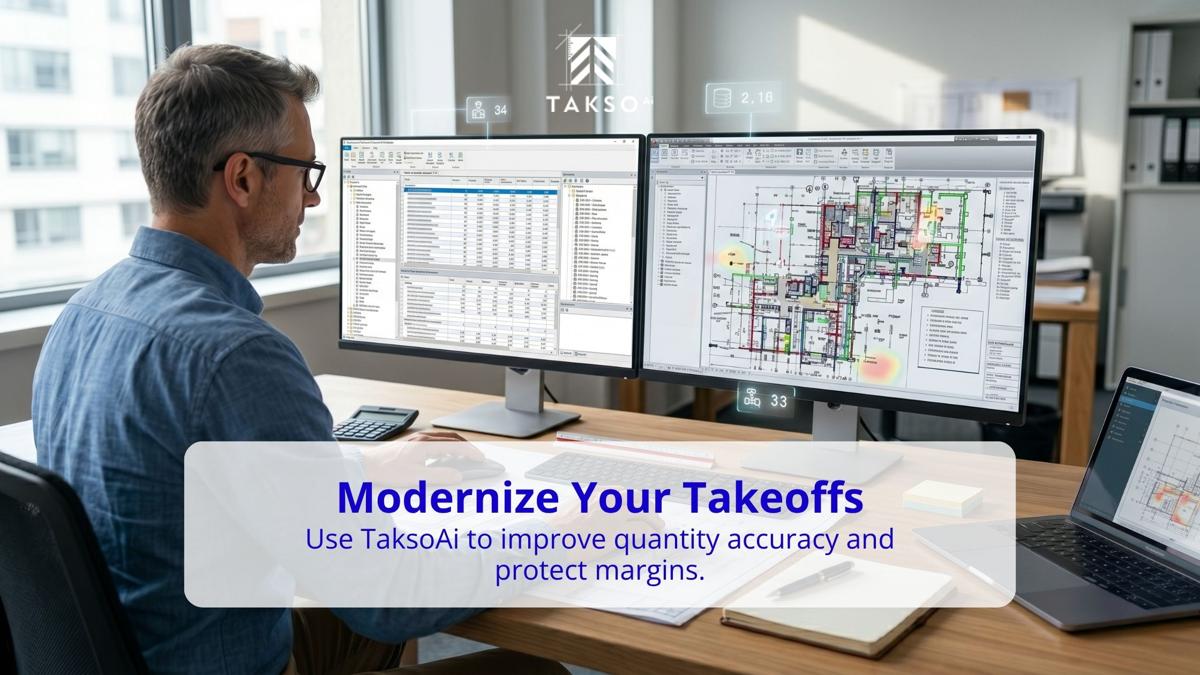
Manual vs. Digital Takeoff Methods, Why Process Choice Matters
Traditional manual takeoffs often involve:
- Physical documents
- Scale ruler measurements
- Hand measurements
- Spreadsheet entries
- Rules of thumb
- Manual rechecks
This process can work. But it also depends heavily on personal consistency.
Digital takeoffs introduce:
- Digital measurement tools
- Automated takeoff software
- Construction takeoff software
- Color coding
- Cloud systems with internet access
- Faster material quantity organization
The difference is not old versus new.It is variability versus standardization. Manual takeoffs often rely on memory and repetitive focus.
Digital systems create structure. The National BIM Standard’s Design to Quantity Takeoff for Cost Estimating resource highlights digital quantity takeoff workflows as a way to improve consistency, standardization, and cost estimating precision across larger, more complex projects.
Digital workflows, especially those built for modern estimators, help reduce avoidable friction while preserving proven estimating expertise.
The Ceiling of Manual Takeoffs Becomes Clear at Scale
Humans are capable. Humans are also inconsistent.
As project complexity grows:
- Repetition increases
- Errors compound
- Inaccurate calculations rise
- Review speed slows
- Scope gaps widen
This is where manual systems begin to struggle. At TaksoAi, we support cloud-based and automated solutions that help estimators standardize repetitive quantity extraction, improve consistency, and reduce missed details. Not by replacing estimators. By supporting them.
How AI Strengthens Takeoff Accuracy Without Replacing Industry Expertise
AI estimating software works best as workflow support.
Benefits of takeoff software include:
- Faster quantity extraction
- Reduced human error
- Better material tracking
- More structured detailed reporting
- Cleaner system standardization
- Improved bid confidence
Understanding how AI improves takeoff accuracy means recognizing its ability to reduce predictable breakdowns like missed fittings, duplicate counts, visual fatigue, and inconsistent workflows.
It allows estimators to spend less time on repetitive counting and more time validating scope. That is the real advantage.
Key Takeaways
- Blueprint takeoffs form the foundation of accurate estimates, material forecasting, labor planning, and dependable project budgeting.
- Manual takeoffs are vulnerable to human fatigue, missed fittings, inconsistent measurements, and scope gaps, especially on larger or more complex projects.
- Structured workflows, multiple review passes, and disciplined quantity tracking improve takeoff consistency and help reduce costly estimating errors.
- Digital workflows and automated mechanical estimating help reduce repetitive quantity extraction while preserving estimator oversight and decision-making.
- Platforms like TaksoAi support modern blueprint takeoff workflows by improving consistency, reducing missed details, and helping teams produce stronger, more dependable estimates.
FAQs About Blueprint Takeoffs
What is a blueprint takeoff in construction?
A blueprint takeoff is the process of extracting measurable quantities and material requirements from construction drawings in order to create accurate estimates. This includes lengths, fittings, fixtures, equipment, and other project components that influence material costs, labor planning, and overall project budgeting before construction begins.
Why do blueprint takeoff errors happen?
Blueprint takeoff errors often happen because manual workflows rely heavily on repetitive visual review, hand measurements, and estimator concentration over long periods of time. Dense drawings, inconsistent symbols, scale changes, and missed fittings can all contribute to inaccurate counts and scope gaps during the takeoff process.
What is the difference between a takeoff and an estimate?
A takeoff identifies the quantities and measurable scope required for a project, while an estimate applies pricing, labor costs, markup, and budgeting to those quantities. Accurate takeoffs are essential because incorrect quantity extraction can create inaccurate estimates, purchasing issues, and reduced profitability later in the project lifecycle.
How do digital takeoffs improve accuracy?
Digital takeoffs improve accuracy by reducing manual counting, organizing quantity tracking more consistently, and helping estimators standardize review workflows across projects. Features like color coding, digital measurements, and structured quantity extraction help reduce missed details, repetitive fatigue, and inconsistent calculations during blueprint review.
Can AI improve blueprint takeoff accuracy?
Yes. AI-powered takeoff tools help reduce repetitive counting errors, missed fittings, duplicate quantities, and inconsistent manual workflows. Understanding how AI improves takeoff accuracy means recognizing how automation supports estimator workflows while still allowing professionals to review scope, validate quantities, and apply project expertise.
Are manual takeoffs still useful today?
Yes. Manual takeoffs can still be effective, especially on smaller or less complex projects. However, as project size and drawing complexity increase, manual workflows become more vulnerable to fatigue, missed scope, and inconsistent quantity extraction, which is why many teams are adopting digital and AI-supported estimating workflows.
Better Blueprint Takeoffs Protect Profit Before the Bid Ever Leaves Your Desk
Blueprint takeoffs are not administrative paperwork.They are profit protection.
When takeoffs fail:
- Material expenses increase
- Labor costs shift
- Markup shrinks
- Errors multiply
- Estimates weaken
Traditional methods still have value, but they also come with limitations. TaksoAi helps teams modernize blueprint takeoffs without abandoning proven practices. It improves blueprint interpretation, strengthens quantity workflows, and supports more competitive bids through cleaner, more dependable quantity extraction.
Because before you can price accurately, you have to count accurately. And in construction, profitability often depends on what you did not miss.