
How AI Mechanical Estimating Frees You to Solve Real-World Jobsite Problems

Mechanical estimating has always demanded precision, but it has also quietly demanded something else: time. Hours spent counting fixtures, measuring runs, and extracting quantities from drawings often leave little room for what actually determines whether a project succeeds. The irony is that the most experienced estimators, the ones who understand jobsite realities best, are often the ones spending the most time on repetitive work.
AI is beginning to change that balance. Not by replacing estimators, but by removing the layers of manual effort that prevent them from applying their expertise where it matters most. When repetitive takeoffs are automated, estimating becomes less about counting and more about thinking. That shift is where real value is created, and it is exactly what modern tools like TaksoAi are designed to support.
The Limits of Traditional Mechanical Estimating
Traditional mechanical estimating workflows are still heavily rooted in manual takeoffs. Estimators spend hours counting components, measuring ductwork and piping, and extracting quantities from 2D drawings. Even when supported by construction estimating software, much of the process still depends on manual input and repetitive review.
This approach creates a bottleneck. It demands focus and accuracy, but it does not fully utilize the estimator’s experience. Instead of evaluating site conditions, reviewing constructability, or identifying potential risks, estimators are often locked into the quantification process itself. Studies comparing manual and automated takeoff methods show how heavily traditional workflows rely on time-intensive measurement and counting processes, limiting efficiency and scalability.
Many teams rely on outdated workflows that do not integrate well with broader systems like construction ERP platforms or construction management software. As projects become more complex, this gap becomes more noticeable. Estimators are expected to contribute more insight, but their time is still consumed by tasks that do not require that level of expertise. Even modern mechanical estimating software can fall short if it still relies heavily on manual effort.
AI and Automation in Construction Estimating
AI and automation in construction estimating are not just about speed. They represent a shift in how estimating work is structured. AI-powered estimating platforms use machine learning, pattern recognition, and data extraction to automate takeoff tasks and streamline the quantification process.
This includes identifying components across drawings, measuring system layouts, and organizing data into usable formats. These capabilities fit into both 2D and 3D workflows and can integrate with BIM for takeoffs or other digital project systems. Research into AI-driven construction estimating highlights how combining automation with BIM workflows can significantly improve both efficiency and consistency in quantity takeoffs.
What this means in practice is that estimators no longer need to spend the majority of their time gathering data. Instead, they can move more quickly into reviewing and interpreting that data. Platforms like the TaksoAi estimating platform are designed around this principle, helping teams move from raw takeoffs to actionable insights faster and with greater clarity.
Unlike workflows that depend heavily on BIM modeling or embedded metadata, TaksoAi is designed to work directly from construction drawings and PDFs, making AI-powered estimating more accessible to contractors working within real-world project timelines and documentation standards.
What AI Mechanical Estimating Software Eliminates From the Process
The most immediate impact of AI is the removal of repetitive, low-value tasks. Manual counting of fixtures, fittings, and components across drawings can be automated. Measuring ductwork and piping systems no longer requires tracing every run by hand. Repetitive takeoff logic across multiple sheets can be handled consistently and quickly.
This reduction in manual work does more than improve speed. It reduces fatigue and helps maintain accuracy across the entire estimate. When estimators are not overloaded with repetitive tasks, they are better positioned to review results critically and identify inconsistencies early.
The rise of AI estimating tools and automated takeoffs is not about replacing effort entirely. It is about reallocating effort. Time that was once spent on extraction can now be used for evaluation, coordination, and planning.
Where Estimators Actually Add Value
Estimating has never been just about numbers. It is about understanding how a project will actually be built. This includes evaluating access constraints, planning material staging, anticipating labor challenges, and assessing how sequencing will affect productivity.
These are decisions that cannot be pulled directly from drawings. They require experience, judgment, and a deep understanding of jobsite realities. When estimators are freed from repetitive takeoffs, they can focus on these higher-value considerations.
This is where the real benefits of AI takeoff software for estimators become clear. The advantage is not just faster estimates. It is better-informed estimates that reflect how projects behave in the real world.
Thinking Beyond the Drawings
Drawings are a starting point, but they are never the full picture. They often lack detail around site conditions, installation challenges, and logistical constraints. Experienced estimators understand this and rely on past projects to fill in the gaps.
AI creates the time needed to think beyond the drawings. Instead of rushing through takeoffs, estimators can assess whether layouts are practical, whether routing makes sense, and whether hidden risks exist within the scope.
This level of thinking improves both accuracy and reliability. It helps teams identify issues early, before they turn into costly problems during construction. It also supports stronger bid strategies, as estimators can account for factors that are not immediately visible in the plans.
Coordination and Clash Awareness
Mechanical systems rarely exist in isolation. They interact with structural elements, electrical systems, and architectural constraints. Poor coordination can lead to clashes, delays, and expensive rework.
When estimators have more time to review projects holistically, they can identify potential conflicts earlier. They can assess how systems will interact and whether installation sequences are realistic.
This goes beyond basic clash detection. It is about applying real-world understanding to anticipate problems before they occur. For teams using modern estimating tools for contractors, this level of coordination awareness becomes a key advantage in both planning and execution.
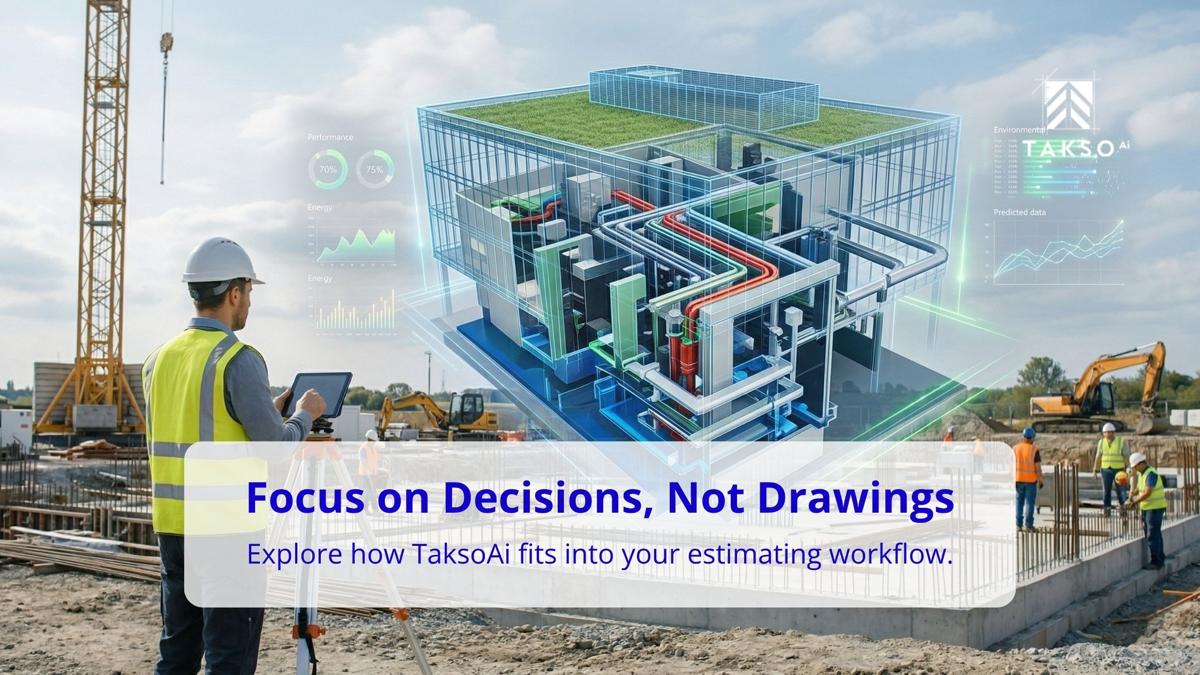
From Quantity Counter to Problem Solver
AI is enabling a shift in how the estimator’s role is defined. Instead of being focused primarily on extracting quantities and reading drawings, estimators are becoming more involved in strategic planning and risk identification.
This shift reflects the true value of the role. Estimators are not just technicians. They are problem solvers who help shape how a project will be executed. They assess feasibility, identify gaps, and contribute to decisions that affect timelines, costs, and outcomes.
By removing repetitive tasks, AI allows this role to evolve naturally. Estimators can spend more time reviewing scope, refining assumptions, and improving the overall quality of their work.
Balancing AI With Human Expertise
Adopting AI in construction estimating requires a balanced approach. While automation can improve speed and consistency, human oversight remains essential. Estimators provide context, interpret results, and apply judgment that cannot be replicated by software alone.
Challenges such as implementation, training, and integration with existing workflows are part of the transition. However, when AI is used to support rather than replace expertise, the results are significantly stronger. Broader industry research reinforces that the most effective outcomes come from combining AI automation with human decision-making, particularly in areas like risk assessment and project planning.
Government-backed research in Canada also emphasizes that successful AI adoption depends on integrating these tools into real-world workflows rather than treating them as standalone solutions.
TaksoAi is designed with this balance in mind. It supports practical workflows and reflects the realities of mechanical estimating environments, where deadlines are tight and conditions are constantly evolving. For contractors exploring ai estimating software, the goal should always be to enhance decision-making, not just automate tasks.
Future Trends in AI Construction Estimating
AI in construction estimating is continuing to evolve beyond takeoffs. Emerging capabilities include advanced predictive analytics, historical data comparison, and predictive modeling that can help teams anticipate costs, risks, and market conditions more effectively.
Machine learning algorithms are becoming more sophisticated, enabling better pattern recognition and improved forecasting. Technologies such as Faster R-CNN and YOLOv7 are advancing how visual data from drawings is interpreted, particularly in complex 2D and 3D workflows.
There is also growing interest in sustainability metrics. Estimating tools are beginning to incorporate elements such as carbon footprint calculations, embodied carbon, and operational emissions. As environmental considerations become more important, these capabilities are likely to play a larger role in how projects are evaluated.
Industry research from construction associations also shows that AI is increasingly being used to support planning, scheduling, and early-stage decision-making across complex projects.
These trends point toward a future where estimating is not just about quantifying materials, but about providing deeper insight into how projects will perform.
Key Takeaways
- AI mechanical estimating reduces repetitive takeoff work, allowing estimators to focus more on planning, coordination, and jobsite problem-solving.
- Automated quantity extraction improves consistency and helps reduce errors caused by manual counting and measurement fatigue.
- Experienced estimators remain essential because AI supports data extraction, while human expertise drives constructability review, risk assessment, and strategic decision-making.
- Modern platforms like the TaksoAi estimating platform help contractors streamline estimating workflows directly from 2D drawings and PDFs without requiring complex BIM models.
- As AI construction estimating continues to evolve, estimators are shifting from quantity counters to more strategic contributors across planning and project execution.
FAQs About AI Mechanical Estimating
How does AI mechanical estimating improve jobsite planning?
AI mechanical estimating improves jobsite planning by reducing the time spent on repetitive quantity takeoffs and manual measurement tasks. This gives estimators more time to review constructability, identify coordination issues, evaluate labor requirements, and assess logistical challenges before construction begins, leading to more accurate planning decisions and fewer surprises during execution.
Does AI replace mechanical estimators?
No. AI is designed to support mechanical estimators, not replace them. Automated takeoffs help eliminate repetitive counting and measurement tasks, but experienced estimators still provide the judgment, project understanding, and real-world decision-making needed to assess risks, review constructability, and produce reliable estimates that reflect actual jobsite conditions.
Can AI estimating software work without BIM models?
Yes. Many modern AI estimating platforms, including the TaksoAi estimating platform, are designed to work directly from 2D PDF construction drawings without requiring BIM models or embedded metadata. This makes AI estimating more practical for contractors and estimators working within traditional project documentation workflows.
How accurate is AI mechanical estimating software?
AI mechanical estimating software can significantly improve consistency and reduce human error during quantity takeoffs. Accuracy still depends on drawing quality, estimator review, and workflow setup, but AI helps automate repetitive calculations and identify components more efficiently, allowing estimators to focus more attention on validating scope, constructability, and project-specific requirements.
What types of projects benefit most from AI estimating tools?
AI estimating tools are especially valuable on large or complex mechanical projects involving extensive piping, ductwork, plumbing systems, or repetitive takeoff requirements. Contractors handling multiple bids, tight deadlines, or high drawing volumes can benefit from faster quantity extraction, improved consistency, and more time for coordination and planning activities.
Time Back Where It Matters Most
At its core, AI mechanical estimating is about time. Not just saving time, but redirecting it. When estimators are no longer consumed by repetitive takeoffs, they can focus on the factors that actually influence project success.
They can review scope more thoroughly, identify risks earlier, and contribute to better planning and coordination. They can move from producing numbers to making decisions.
That is the real advantage. If you are ready to see how this shift can work within your own workflow, you can get demo access and explore how TaksoAi helps estimators focus on solving real-world jobsite problems.