
From 2D Drawings to Real-World Piping Installs with AI Takeoffs

There is a quiet gap in every piping project. It exists between what is drawn and what is built, between clean lines on a page and the complexity of a real jobsite. For decades, estimators and contractors have worked inside that gap, translating 2D drawings into something that can actually be installed. It has always required experience, judgment, and time.
AI takeoffs are digital estimating tools that use artificial intelligence to extract piping quantities, fittings, and system data directly from 2D construction drawings. They are beginning to change how that translation happens.
This is not about automation for the sake of speed. It is about creating space for better decisions. When repetitive takeoff work is handled faster and more consistently, estimators can focus on what actually determines whether a piping system will work in the field. That is where projects succeed or fail.
The Problem with Perfect Drawings
On paper, everything looks clean and coordinated. Lines are straight, spacing is consistent, and systems appear to fit together without conflict. It creates the impression that installation is simply a matter of execution.
In reality, 2D drawings represent a simplified version of what will happen on-site. They do not account for the full range of conditions that affect installation, including hidden structural elements, tight ceiling spaces, interference from other trades, and site-specific limitations.
What appears straightforward in a drawing often becomes complex during installation. This is why estimators are not just reading drawings, they are interpreting them and preparing for what is not shown.
Tools like TaksoAi, a modern piping estimating software, support this process by accelerating the early stages, allowing more time for deeper evaluation and planning.
Industry standards like the National Plumbing Code of Canada reinforce that real-world systems must meet strict performance and safety requirements that go beyond what is shown in drawings.
AI Does Not Replace Judgment. It Removes the Busywork
AI takeoffs are often misunderstood as a replacement for estimators. In practice, they remove the manual tasks that consume a large portion of an estimator’s time.
Measuring pipe runs, counting fittings, and extracting quantities from drawings are necessary steps, but they are not where expertise is applied. AI handles these tasks efficiently and consistently, generating structured data directly from drawings.
What AI does not do is account for real-world variables. It does not evaluate constructability, anticipate installation challenges, or adjust for jobsite constraints. Those decisions remain with experienced professionals.
The value of AI is that it gives estimators more time to focus on those decisions. As outlined in the ASPE Plumbing Engineering Design Handbook, translating drawings into real systems requires engineering judgment that goes far beyond basic quantity takeoffs.
From Manual Takeoffs to AI-Driven Piping Workflows
Traditional takeoffs require sustained attention across hundreds of small details, increasing both time investment and the likelihood of error. AI-driven plumbing and piping takeoff automation changes how this work is approached.
Instead of manually reviewing each element, estimators can extract accurate quantities quickly and consistently using AI-powered takeoff and estimates. These systems rely on digital plan measurement, equipment, fixtures and device recognition, and on-screen takeoff technology to streamline the process.
They also support:
- Assembly creation and custom assemblies
- Material and labor cost databases
- System-ready data outputs for estimating and planning
This allows teams to reduce repetitive workload, standardize outputs across projects, and move faster from drawings to decisions. The estimator’s role shifts from gathering data to evaluating it, which is where mechanical takeoff solutions for contractors begin to create meaningful value.
What AI Actually Sees. And What It Doesn’t
AI is highly effective within its scope, but it is limited to what is present in the drawings. It identifies symbols, measures distances, and extracts structured data using automated recognition of fittings and fixtures.
It does not account for conditions that are not documented, such as field constraints, coordination challenges, or gaps in design. This is why estimator oversight remains critical.
Most platforms include an intuitive review process that allows professionals to validate outputs before they are used. Accuracy, quality assurance, and trust in AI takeoffs depend on this balance. AI provides consistency, while experienced estimators ensure the data reflects real-world conditions.
The Real Advantage Is Time
The most significant benefit of AI takeoffs is not just speed, but how that saved time is used. When estimators are no longer focused on manual tasks, they can shift their attention to higher-value work. This includes reviewing layouts more critically, identifying potential issues earlier, and planning for installation challenges before they occur.
Instead of reacting to problems in the field, teams can address them during estimating. This is where how AI is improving construction estimating becomes clear. It allows professionals to move beyond data collection and focus on execution, which has a direct impact on project outcomes.
Filling in the Gaps Left by 2D Plans
Every drawing leaves some level of ambiguity. These gaps are not always obvious at first, but they often surface during installation when adjustments are required.
With more time available, estimators can proactively identify these areas. They can evaluate where layouts may need adjustment, where space constraints could create challenges, and where coordination with other trades is necessary.
This process relies on experience. AI supports it by reducing the time spent on preliminary work, allowing estimators to apply their knowledge more effectively and earlier in the process.
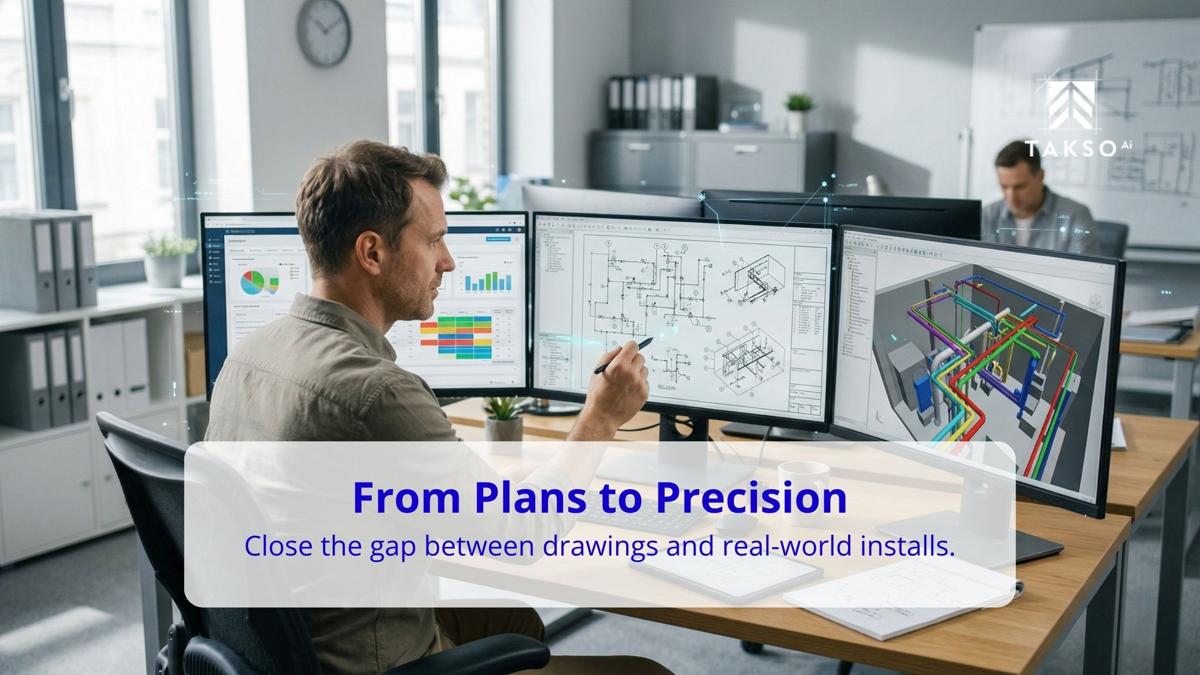
When Straight Lines Become Real-World Problems
Drawings often present piping systems as clean, uninterrupted paths. In practice, these paths are rarely that simple.
Installation conditions introduce variables such as structural obstructions, conflicts with HVAC and electrical systems, limited clearance, and unexpected site conditions. These factors require adjustments that are not visible in 2D plans.
AI tools support a wide range of project types, including residential plumbing estimating software, commercial plumbing estimating software, and industrial piping projects. These may involve:
- Water supply piping and sanitary drainage systems
- Storm drainage systems and sewer repair takeoffs
- Gas piping takeoff and backflow preventers
- Fixture counts by type and grease interceptors
Across all of these applications, drawings provide a starting point. Real-world execution depends on preparation, flexibility, and the ability to adapt. Municipal plumbing guides also show how water supply, drainage, and venting systems interact in complex ways that are not always fully represented in 2D plans.
Real-World Clash Awareness Starts Before Installation
Clash awareness is not limited to digital coordination tools. It begins during estimating, when potential conflicts can be identified early.
With more time available, estimators can assess how systems interact and where issues may arise. This includes identifying high-risk areas, evaluating spacing, and anticipating adjustments before installation begins.
AI contributes by reducing the time spent on takeoffs, allowing for more thorough analysis. One of the key features of AI takeoff tools is that they enable better foresight, helping teams reduce rework, avoid delays, and improve overall coordination. Guidelines like the GSA BIM Guide emphasize that coordination and clash awareness must extend beyond drawings into real-world execution and lifecycle planning.
Connecting Estimating to What Happens in the Field
A common challenge in construction is the disconnect between estimating and field execution. Estimates are built from drawings, while installations are shaped by real conditions.
AI helps bridge this gap by providing consistent, structured data that can be shared across teams. Cloud-based workflows make this information accessible, while project management tool integration ensures it flows directly into execution planning.
This improves communication, aligns expectations, and supports better coordination between estimators and field crews. Integration and output formats are essential here, ensuring that data is not just created, but actively used. In practice, installation also involves permits, inspections, and staged approvals, as outlined in Ontario residential plumbing guidelines, further highlighting the gap between plans and execution.
This is how TaksoAi builds AI estimating solutions to support real-world workflows.
Scaling Without Losing Accuracy
As project volume increases, maintaining consistency becomes more difficult. Manual processes introduce variability that can affect both accuracy and efficiency.
AI provides a standardized approach to takeoffs, allowing teams to maintain quality across multiple projects. This enables consistent results, reduces variability between estimators, and supports scalable workflows.
For teams managing multiple jobs, pipelines estimating software and AI tools provide a way to increase capacity without sacrificing precision. This balance is critical for long-term growth.
Best Practices for Using AI in Piping Takeoffs
Adopting AI requires a shift in workflow, not a complete replacement of existing processes. The most effective approach is to integrate AI into how teams already operate, using tools like TaksoAi to support, not disrupt, existing estimating practices.
Best practices include using AI outputs as a baseline, reviewing results carefully, and incorporating takeoff data into broader planning and coordination efforts. Training and support also play an important role in ensuring teams can apply the technology effectively.
When used correctly, AI enhances existing expertise rather than replacing it. With platforms like ours handling the repetitive groundwork, teams can improve efficiency while maintaining control over accuracy, coordination, and execution.
Key Takeaways
- AI takeoffs help reduce repetitive estimating work on piping projects.
- Estimators remain essential for reviewing constructability and field conditions.
- Faster quantity extraction creates more time for coordination and planning.
- AI improves consistency across large or multi-project estimating workflows.
- Better estimating workflows lead to fewer surprises during installation.
Frequently Asked Questions About AI Piping Takeoffs
How do AI takeoffs work for piping projects?
AI takeoff software analyzes 2D construction drawings to automatically identify pipe runs, fittings, fixtures, valves, and mechanical components. Instead of manually measuring every element, estimators can generate structured quantity data much faster. Platforms like TaksoAi
help contractors streamline piping estimating workflows while improving consistency across projects.
Can AI replace piping estimators?
No. AI takeoff software supports piping estimators by automating repetitive quantity extraction tasks, but experienced professionals still play a critical role in reviewing constructability, field coordination, and installation feasibility. AI helps reduce manual workload, while estimators apply the judgment needed to evaluate site conditions, identify conflicts, and prepare projects for successful installation.
What are the benefits of AI piping takeoffs?
AI piping takeoffs help contractors reduce manual estimating time, improve consistency between projects, and generate more accurate quantity data from 2D drawings. This allows estimating teams to focus more on coordination, planning, budgeting, and constructability reviews instead of repetitive counting and measuring tasks that traditionally consume large portions of the estimating process.
Do AI takeoffs work with standard PDF drawings?
Yes. Most modern AI takeoff platforms are designed to work directly from standard 2D PDF construction drawings without requiring BIM models or embedded metadata. Platforms like TaksoAi use AI-assisted recognition technology to extract piping quantities, fittings, and layout information directly from digital plans used by contractors and estimators.
Why are AI takeoffs useful for mechanical contractors?
AI takeoffs help mechanical contractors process estimates more efficiently while maintaining consistent workflows across multiple projects. By reducing repetitive manual takeoff work, contractors can dedicate more time to coordination, planning, budgeting, and communication between estimating teams and field crews. This helps improve project preparation before installation begins on-site.
Can AI takeoff software help reduce estimating errors?
AI takeoff software can help reduce estimating errors by standardizing quantity extraction and minimizing inconsistencies caused by manual counting or measurement processes. While estimator oversight is still necessary, AI tools provide a more repeatable workflow that supports accuracy, quality control, and better project planning across complex piping and mechanical estimating tasks.
Turning Drawings Into Decisions That Hold Up On Site
Estimating is not just about interpreting drawings. It is about making decisions that hold up during installation.
AI takeoffs accelerate the early stages of this process by handling repetitive tasks and improving consistency. This allows estimators to focus on evaluating plans, anticipating challenges, and preparing for execution.
The role of the estimator is to bridge the gap between what is shown on the drawings and what is actually possible on-site. AI supports this by handling the groundwork, allowing professionals to focus on execution, coordination, and constructability.
By combining automation with real-world expertise, teams can close the gap between 2D drawings and actual piping installs. That is how better decisions are made, and how more reliable projects are delivered.